ASML – the Monopoly Inside the Monopoly
ASML’s monopoly is real, but the moat source is migrating somewhere the sell side hasn’t followed.
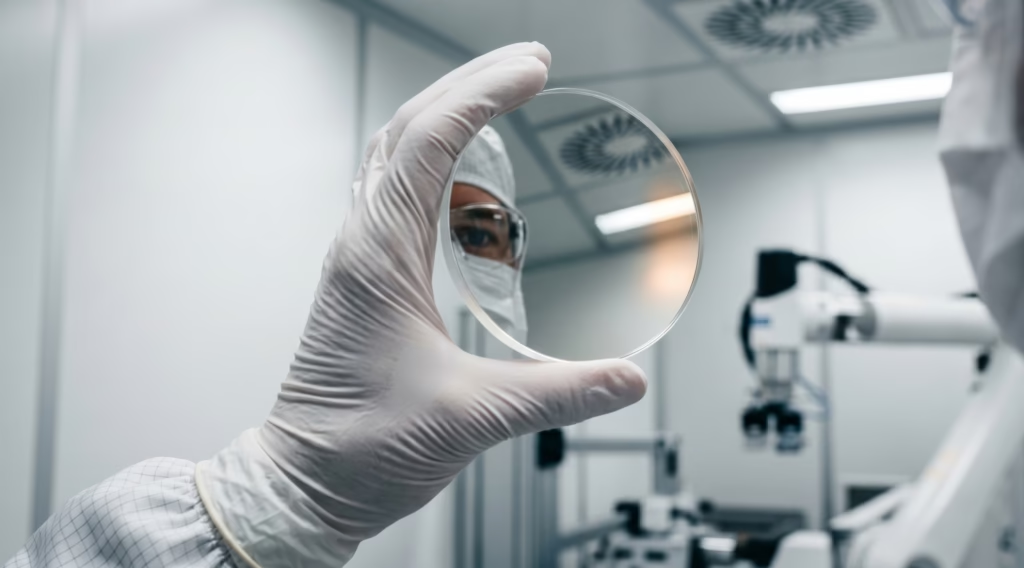
Everyone agrees ASML is irreplaceable. It is the only company on Earth that builds the extreme ultraviolet (EUV) lithography machines required to manufacture every leading-edge AI chip. No ASML, no advanced semiconductors. Period. The Wall Street Journal reminded us again recently: sixty machines planned for 2026, eighty for 2027, a backlog that stretches to the horizon, and a customer list that reads like a summit of sovereign ambitions.
What most coverage misses: the variable that actually constrains ASML’s growth is shifting. It used to be “can ASML build enough machines?” Now it is quietly becoming “can anyone plug them in?” Each EUV tool draws approximately 1 megawatt of continuous power. A cutting-edge fab running 15 to 20 of these machines needs 15 to 20 megawatts just for lithography – before cooling, vacuum systems, or anything else. TSMC’s Arizona fab has already hit power-related delays. Intel’s Ohio site faces similar grid challenges.
The sell side still models ASML as supply-constrained. The emerging reality is that it may be demand-constrained – not because customers don’t want to buy, but because the electrical grid can’t absorb what they’ve ordered. That reframing changes the investment map.
And while the world watches ASML, the single most irreplaceable subsystem in the entire AI supply chain – the ultra-precision mirror sets inside every EUV machine – is manufactured by a German optics subsidiary called Zeiss SMT that almost nobody discusses. Zeiss wins whether ASML ships sixty machines or eighty, whether High NA succeeds or fails, whether the customer is TSMC, Intel, or Samsung. It is the monopoly inside the monopoly.
Terms You’ll Need
Every acronym and term used in this piece, defined in plain English.
- EUV (Extreme Ultraviolet Lithography): The process of using very short wavelengths of light to print transistor patterns on silicon wafers. Only ASML makes EUV machines.
- High NA EUV: The next generation of EUV, using a wider-angle lens (higher “numerical aperture”) to print even smaller features. ASML’s EXE:5000 series. Still in early adoption.
- DUV (Deep Ultraviolet Lithography): The older, less precise lithography technology. Still used for many chip layers and mature manufacturing nodes.
- Zeiss SMT: A subsidiary of Carl Zeiss AG that manufactures the mirror systems inside every EUV machine. The sole supplier on Earth.
- TSMC (Taiwan Semiconductor Manufacturing Company): The world’s largest contract chipmaker and ASML’s biggest customer.
- Fab: A semiconductor fabrication facility – the factory where chips are made.
- Node (e.g., 2nm, 7nm, 14nm): A generation of chip manufacturing technology. Smaller numbers generally mean more advanced, more powerful, more power-efficient chips.
- Chiplet: A design approach where a processor is built from multiple smaller chip tiles connected together, rather than one large monolithic die.
- Multi-patterning: Using multiple lithography passes to achieve finer detail than a single exposure allows – a workaround that can delay the need for High NA.
- NAV (Net Asset Value): The underlying value of a fund’s holdings, used in ETF (Exchange-Traded Fund) pricing.
- Book-to-bill ratio: New orders divided by revenue shipped. Above 1.0 means orders are growing faster than shipments.
- ASP (Average Selling Price): The average price at which a product sells.
- TenneT: The Dutch national electricity grid operator.
- Capex (Capital Expenditure): Money companies spend on physical assets – factories, equipment, infrastructure.
- MER (Management Expense Ratio): The annual fee charged by a fund, expressed as a percentage of assets.
4 assumptions, all fragile
Wall Street has a consensus on ASML that is correct on the headline and dangerously lazy on the mechanism.
1. The monopoly is durable through at least 2030 – a “toll booth” on all AI infrastructure spending.
2. The production ramp (60 units in 2026, 80 in 2027) is achievable because ASML pre-invested in clean rooms and supply chain coordination.
3. High NA EUV is the next growth curve – delays merely push revenue into later years without shrinking the market.
4. The $600B+ hyperscaler capex supercycle provides a multi-year, demand-insensitive tailwind. The only question is how fast ASML can ship, not whether customers will buy.
Each of these is plausible. None is as solid as the market treats it.
The Moat Is Migrating
Each EUV machine consumes approximately 1 megawatt of continuous power, and that changes everything.
The technology moat is mature and stable. Nobody is replicating ASML’s tin-plasma light source and precision optics system. But what’s actually constraining the system now is not whether ASML can build machines – it’s whether fabs can absorb them.
A leading-edge fab running 15 to 20 EUV tools needs 15 to 20 MW just for lithography, before cooling and ancillary systems. If power becomes the binding constraint, ASML’s unit guidance becomes secondary. Customers may order 80 machines but only install 65 because fab power connections aren’t ready. That creates a phantom backlog – order book metrics look robust while near-term revenue recognition stalls.
What to watch: Track fab construction delays attributed to power grid connections. Monitor ASML’s “units shipped” versus “units installed and accepted” divergence in quarterly filings. If the gap widens beyond 5 to 8 percent, the power constraint thesis is gaining force.
The scenario to explore: If energy delivery to fabs is the real bottleneck, the structural advantage may sit with companies solving grid-scale power in semiconductor manufacturing regions – not with ASML itself.
Coordination Fails Non-Linearly
The real ramp decision was made in mid-2025, when ASML was still guiding flat.
ASML’s production isn’t a factory assembly line. It is a synchronized ballet of roughly 800 suppliers, many of them capacity-constrained small and mid-size enterprises in the Netherlands, Germany, and Japan. Complex system ramps don’t fail gradually – they fail at threshold points.
A 36 percent ramp in a single year, for a product with 6 to 12 month assembly cycles, means every supplier needed to begin ramping 6 to 12 months ago. That places the real commitment point in mid-2025, when ASML was still guiding flat for 2026. The timing mismatch between guidance revisions and supplier lead times implies the supply chain may not have fully committed to the 60-unit target. ASML may hit 55 to 58 units and call it a win – but the market is positioned for 60-plus with upside.
What to watch: Listen for language shifts on ASML’s Q2 2026 earnings call – from “at least 60” to “approximately 60” or “in the range of 58 to 62.” Monitor Zeiss SMT delivery timelines in German trade press. Track ASML employee headcount growth versus plan – if hiring lags by more than 500 FTEs, assembly integration will bottleneck.
The scenario to explore: A 5 to 8 percent miss on units could trigger a disproportionate sentiment correction, not because the business is broken but because the market has priced precision into a system that operates on coordination.
The Staircase, Not the Escalator
The demand story isn’t an escalator – it’s a staircase, and the landing could arrive right when ASML expects to ship 80-plus units.
The $600B hyperscaler capex figure conflates building costs (concrete, cooling, electrical) with semiconductor procurement, which itself conflates mature-node chips with leading-edge logic where EUV is required. The actual ASML-relevant capex is roughly $20 to 40 billion annually.
More critically, hyperscaler capex cycles have historically been 3 to 4 year waves followed by 12 to 18 month digestion periods. The current wave began in earnest in 2023. If historical patterns hold, 2027 to 2028 could see deceleration from 40-plus percent year-over-year growth to 10 to 15 percent. For ASML, this doesn’t mean revenue falls – it means the rate of new orders declines, compressing the backlog-to-revenue ratio that supports premium multiples. Markets price momentum, not levels. Momentum peaks first.
What to watch: Hyperscaler capex guidance revisions in Q3 to Q4 2026 earnings calls. TSMC’s 2027 capex guidance. ASML’s book-to-bill ratio – new orders divided by revenue shipped – if it drops below 1.0x for two consecutive quarters, the cycle is turning. Monitor for any hyperscaler mentioning “capex efficiency” or “optimization” – euphemisms for deceleration.
The scenario to explore: If the landing arrives in 2027 to 2028, precisely when ASML has ramped to 80-plus unit capacity, the company could face a classic cyclical overcapacity problem invisible today because everyone is focused on the current shortage.
High NA Delay Is Margin Protection
The market models High NA delay as “revenue pushed right” – it should model it as “margin protection now.”
Standard EUV machines have mature manufacturing processes, well-understood supply chains, and gross margins north of 55 percent. High NA machines are first-generation products with lower initial yields, higher warranty and service costs, and gross margins likely 5 to 10 percentage points below standard EUV during their first 2 to 3 years of volume production.
Every year that TSMC extends standard EUV life – through multi-patterning, process optimization, and wafer throughput improvements – is a year that ASML ships high-margin, low-risk units instead of low-margin, high-risk ones. This inverts the typical analyst narrative. ASML’s 2026 to 2027 margins could surprise to the upside precisely because High NA isn’t scaling yet.
The real long-term risk isn’t that High NA is delayed. It’s that High NA is never needed at scale – because standard EUV plus multi-patterning plus chiplet architectures provide a sufficient roadmap through 2nm and below. That scenario compresses ASML’s long-term addressable market, but it’s a 2029-plus problem.
What to watch: TSMC’s N2 and A16 node yields on standard EUV – if yields exceed 85 percent without High NA, the delay extends further. ASML’s gross margin trajectory in Q2 to Q4 2026: margins exceeding 56 percent would strengthen the “standard EUV is the better business” thesis. Intel’s High NA pilot line output – struggles with EXE:5000 yields would validate TSMC’s conservatism.
The scenario to explore: The margin surprise story for 2026 to 2027 may be hiding in plain sight – not in unit beats, but in product mix favoring mature, high-margin standard EUV.
The Monopoly Inside the Monopoly
The ultimate asymmetric position in the AI supply chain isn’t ASML – it’s ASML’s captive optics supplier.
The ultra-precision EUV mirror systems – each requiring nanometer-scale surface accuracy over areas the size of a dinner plate – are manufactured exclusively by Zeiss SMT, a subsidiary of Carl Zeiss AG, in Oberkochen, Germany. These mirrors cannot be sourced from any other supplier on Earth. ASML’s machines are essentially Zeiss optics surrounded by an elaborate tin-vaporization and wafer-handling system.
Each mirror set takes 6 to 18 months to manufacture and requires surface roughness below 0.03 nanometers – less than the diameter of a single atom. The production facility relies on decades of institutional knowledge, specialized polishing equipment, and a small cadre of master opticians. It cannot be replicated quickly.
Zeiss SMT captures value whether ASML ships 60 units or 80, whether High NA succeeds or fails, whether the customer is TSMC, Intel, or Samsung. Even in a demand downside scenario, replacement optics and mirror servicing for the installed base generate recurring revenue. The installed base only grows; mirrors degrade and need periodic replacement. Zeiss wins on volume or on maintenance – or both.
If ASML wants to go from 60 to 80 to 100-plus units per year, Zeiss SMT must expand proportionally. But Zeiss SMT is a subsidiary of a diversified optics company whose incentives are not perfectly aligned with ASML’s growth ambitions. If Zeiss caps at 70 mirror sets annually due to physics constraints, ASML’s production ceiling drops to 70 regardless of everything else. This is a single-point-of-failure risk that is invisible to the market because Zeiss SMT doesn’t hold public earnings calls.
What would break this asymmetry: A breakthrough in alternative EUV optics materials or a fundamental shift away from reflection-based EUV lithography entirely. Both are 10-plus year horizon events with low probability.
The scenario to explore: Carl Zeiss AG (parent company) trades at a fraction of ASML’s valuation despite controlling the single most irreplaceable component in the AI chip supply chain. The thesis is complicated by Zeiss AG’s diversified structure – Zeiss SMT is not independently traded – but as the semiconductor division grows as a share of group profits, the embedded optionality becomes harder to ignore. Worth a closer look via AFX.DE (Carl Zeiss Meditec AG), the publicly traded arm offering indirect, imperfect exposure.
The Architectural Shift Nobody Models
If only the compute tiles need leading-edge EUV, the growth elasticity of ASML’s revenue changes fundamentally.
The semiconductor industry is migrating from monolithic dies to chiplet-based architectures – AMD’s EPYC, Apple’s M-series Ultra, Intel’s disaggregated tiles. In a monolithic die, every transistor must be printed on the same leading-edge node, requiring multiple EUV layers. In a chiplet design, only the compute tiles need leading-edge EUV. I/O dies, memory controllers, and interconnect layers can use mature nodes (7nm, 14nm) that don’t require EUV at all.
As chiplets become the dominant design paradigm, the number of EUV layers per unit of compute output decreases. This doesn’t eliminate EUV demand – it changes its growth elasticity relative to total chip demand. If the industry produces 2x more compute but only needs 1.5x more EUV layers, ASML’s revenue growth underperforms the broader semiconductor capex cycle. This is a subtle, multi-year headwind – likely a 5 to 10 percent drag versus monolithic-extrapolation models – that no sell-side analysis captures because they project EUV demand from total wafer starts, not from leading-edge layer counts per design.
The scenario to explore: The compensating growth vector in a chiplet-dominant world is advanced packaging equipment. BESI.AS (BE Semiconductor Industries), a Dutch advanced packaging equipment maker, is directly exposed to this transition. If chiplets reduce EUV layers per compute unit, BESI’s packaging tools become the beneficiary.
The John Deere Playbook
The market values ASML on forward unit shipments when it should be valuing the recurring-revenue annuity underneath.
John Deere’s most profitable business isn’t selling tractors – it’s selling maintenance contracts, software subscriptions, and precision-agriculture data services on its installed base. ASML is quietly executing the same playbook.
Each EUV machine requires ongoing maintenance, calibration, software updates, and periodic hardware upgrades – light source replacements, mirror recoating. Service and upgrade revenue is growing faster than new system revenue and carries higher margins (estimated 60 to 65 percent gross margin versus 52 to 56 percent for new systems). As the installed base crosses 300-plus EUV units globally and heads toward 350-plus by 2028, service revenue could represent 25 to 30 percent of total revenue at superior margins.
This transforms ASML from a cyclical equipment vendor into something closer to an annuity business. The market has not yet made this mental model shift because quarterly reporting still leads with unit shipments, not installed-base metrics.
The scenario to explore: If service revenue grows faster than new system revenue, the revenue mix shift could support a structural re-rating from “cyclical equipment vendor” to “recurring-revenue infrastructure monopoly.” This is the hidden bull case.
The Fragmentation Multiplier
The irony: the more geopolitically fragmented the world becomes, the more monopoly power ASML accrues.
Most analysts model US-China export controls as a headwind – lost Chinese customers. The lateral insight: export controls force duplication of capacity across geopolitical blocs, which increases total machine demand.
Pre-controls, TSMC’s Taiwan fabs served the entire world. Post-controls, the US (CHIPS Act), EU (European Chips Act), Japan, and India are each building domestic leading-edge capacity. Each new fab requires its own set of EUV machines. The US alone is subsidizing 3 to 5 new leading-edge fabs. Europe wants 2 to 3. Japan wants 1 to 2. This geographic fragmentation means the world needs 40 to 60 percent more EUV machines than it would in a frictionless global trade regime.
ASML is the only entity that benefits from every side of the geopolitical divide simultaneously. The US, EU, Japan, South Korea, and even (for mature-node DUV) China all need ASML machines. Every new subsidy program, every new fab announcement, every friend-shoring initiative translates directly into incremental EUV orders.
The scenario to explore: The geopolitical fragmentation of semiconductor supply chains is a multi-decade structural tailwind that paradoxically strengthens with every new trade restriction. The market still treats export controls as a headwind because it focuses on lost Chinese revenue rather than duplicated global capacity.
Three Risks the Market Isn’t Pricing
A physics-constrained optics ceiling, a synchronized capex bust, and a domestic political shift no international investor is watching.
1. Zeiss SMT’s hard ceiling. Mirror polishing cannot be parallelized or accelerated beyond certain limits without sacrificing quality. If Zeiss caps at 70 mirror sets annually, ASML’s production caps at 70 machines – full stop. This single-point-of-failure risk goes undiscussed because Zeiss SMT doesn’t hold public earnings calls.
2. Hyperscaler capex synchronization. All four major hyperscalers are ramping capex simultaneously. Synchronized booms create synchronized busts. If even one (say, Meta, which has the weakest AI revenue relative to capex) announces a cut in 2027, psychological contagion could trigger all four to “rationalize” at once. ASML’s order book provides 12 to 18 months of visibility, but cancellation clauses and order deferrals are less transparent than the headline backlog suggests.
3. Dutch domestic politics. The Netherlands is undergoing a rightward political shift. The combination of a housing crisis in Eindhoven exacerbated by ASML’s growth, immigration policy tightening that could restrict the foreign talent ASML needs, and growing public resentment toward a single company distorting the local economy creates a slow-burn political risk. Workforce regulations, zoning restrictions, or profit-sharing requirements could increase operating costs without any geopolitical trigger. International investors consistently overlook domestically generated risk.
The scenario to explore: The risk that deserves the most attention is the Zeiss capacity ceiling – it is the one constraint that is physics-bound rather than commercially negotiable, and it has the shortest path to impacting unit guidance.
Three Opportunities the Market Is Missing
The market hasn’t made the mental model shift from cyclical equipment vendor to recurring-revenue infrastructure monopoly.
1. The service revenue compound. Covered above in the John Deere section. If the installed base reaches 350-plus EUV units by 2028 and service revenue grows at superior margins, the earnings quality transformation warrants a structural re-rating.
2. Geopolitical duplication. Covered above. The fragmentation of supply chains mechanically increases the number of EUV machines the world requires by 40 to 60 percent relative to a single-fab-location counterfactual. Multi-decade tailwind.
3. ASML as a de facto European strategic asset. ASML is increasingly discussed in European policy circles as comparable to Airbus or LVMH in strategic significance. This creates an implicit sovereign backstop: the Dutch and EU governments have strong incentives to prevent hostile takeover, competitive disruption, or capacity migration. As the European Chips Act deploys billions in subsidies, ASML becomes the primary equipment beneficiary. This sovereign premium – the implicit government guarantee of protection, subsidy, and expansion – is not modeled by sell-side analysts who treat it as a purely commercial entity.
The scenario to explore: When sovereign governments replace corporations as the marginal buyer of advanced compute capacity, the demand curve becomes more inelastic and less cyclical. ASML sits at the center of a five-node geopolitical coordination network (US, EU, Japan, South Korea, Taiwan) where every node has independent incentives to maximize its output. That structural positioning is not yet reflected in how the market thinks about the business.
Commoditization Cascades Upward
Commoditization at the top cascades into premium pricing power at the bottom – a deeply non-intuitive structural advantage.
Unlike GPU design (where AMD, Intel, and startups compete), cloud compute (where AWS, Azure, and GCP compete), or AI models (where OpenAI, Anthropic, Google, Meta, and DeepSeek compete) – EUV lithography has zero competitive alternatives. The entire AI stack above ASML faces commoditization pressure; ASML faces none.
The non-obvious mechanism: as AI model providers commoditize, they compete on cost, which pressures chip companies on pricing, which forces chip companies to buy more productive lithography tools (more wafers per hour, fewer defects) to maintain margins, which means they buy ASML’s latest and most expensive machines and upgrade packages. Commoditization at the top of the stack cascades into premium pricing power at the bottom. ASML’s pricing power is a function of its customers’ desperation, and that desperation increases as their own margins compress.
What to watch: If AI chip ASPs decline (NVIDIA and AMD GPU prices falling), watch whether TSMC increases EUV tool orders to compensate with volume. Rising ASML ASP per EUV tool year-over-year would validate this thesis.
The scenario to explore: ASML may be the only company in the AI value chain whose pricing power increases as the rest of the chain commoditizes. A company whose value proposition is grounded in atoms rather than bits occupies a category of its own.
ASML’s Double-Layered Energy Dependency
ASML could face its own power bottleneck in Brabant before its customers face theirs in Arizona.
Most analysis focuses on customer-side power constraints. But ASML’s energy dependency runs in two directions: its own factories need power to assemble and test machines, and its customers need power to operate them.
ASML’s Veldhoven campus expansion requires significant power infrastructure in a region (Brabant) that already faces grid congestion from rapid industrial growth. Dutch grid operator TenneT has flagged capacity constraints in the Eindhoven region. If leading-edge fabs require 100 to 150 MW each and grid upgrades take 3 to 5 years, ASML’s 80-unit 2027 target becomes physically impossible to install even if it’s possible to manufacture.
What to watch: TenneT grid capacity announcements for the Brabant and Eindhoven region. Any fab construction delay explicitly attributed to power grid readiness. ASML’s energy procurement contracts, if disclosed.
The scenario to explore: Any company solving grid-scale power delivery in semiconductor manufacturing regions – whether through nuclear, gas, or grid modernization – has a structural tailwind the market is underpricing. Constellation Energy (CEG), operator of the largest US nuclear fleet, is one name directly exposed if the energy-as-binding-constraint thesis plays out as fab power demand collides with grid capacity limits in Arizona and Texas.
Names Worth a Closer Look – American Investors
These are not buy recommendations – they are structural positions worth investigating.
- Constellation Energy (CEG) – Operator of the largest US nuclear fleet. Direct beneficiary if the energy-as-binding-constraint thesis materializes as fab power demand collides with grid capacity limits in Arizona and Texas.
- Applied Materials (AMAT) – The largest semiconductor equipment company by revenue outside lithography. Positioned to capture value from every fab buildout driven by geopolitical duplication, regardless of which node those fabs target.
For American investors exploring the ASML ecosystem: Constellation Energy is the power constraint play, and Applied Materials captures the broader fab buildout regardless of EUV-specific dynamics.
Names Worth a Closer Look – European Investors
The nested monopolies and adjacent plays listed on European exchanges.
- Carl Zeiss Meditec AG (AFX.DE)