$AMPX isn’t racing the battery giants—it’s building a toll road they can’t use
The market sees a scale-up story destined to lose to CATL; the reality is a defense supply chain chokepoint hiding in plain sight
The pitch
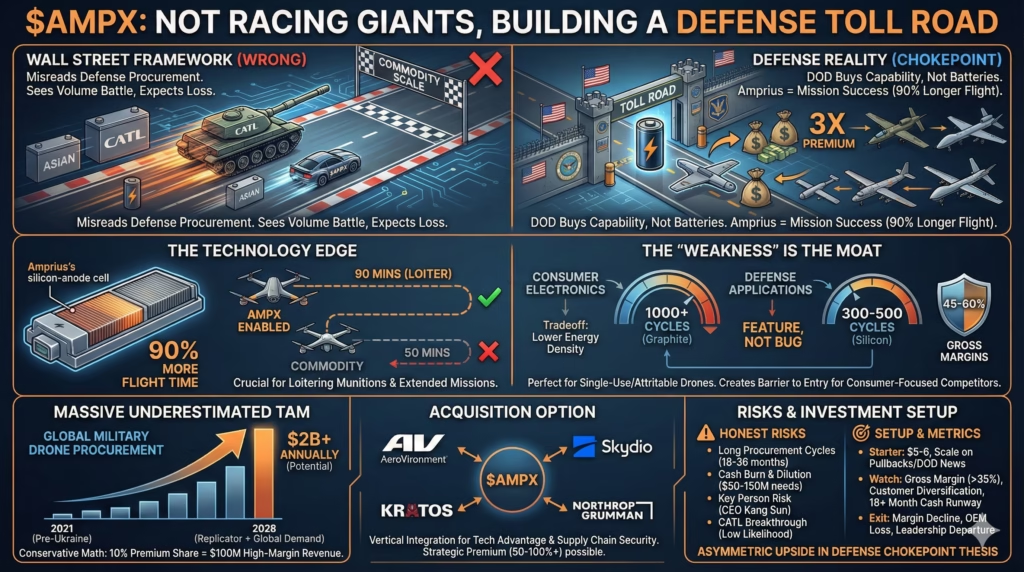
Amprius’s silicon-anode cells deliver 90% longer drone flight times. That’s not a marginal improvement—it’s a capability gap that defense buyers will pay 3x premiums to secure, regardless of what CATL charges for commodity cells. The 2024 NDAA and Replicator Initiative have transformed domestic battery production from nice-to-have into national security mandate, and Amprius is one of vanishingly few U.S.-based manufacturers with production capability for high-energy-density cells.
Wall Street models this as a scale race Amprius must win. The contrarian reality? They may not need to compete on cost at all if they correctly position as the sole-source supplier for performance-critical unmanned systems.
The friction
Defense procurement moves at glacial pace—18-36 months from qualification to meaningful revenue—while Amprius burns cash monthly and trades at a $1.3B valuation requiring near-term validation. The company remains unprofitable with negative operating leverage.
If commercial drone adoption stalls before defense contracts materialize, equity dilution could reach 25-30% over three years. Key person risk compounds everything: CEO Kang Sun’s departure during the critical 2025-2027 scaling window would create a leadership vacuum with no obvious successor.
Time to examine what the numbers actually reveal.
The defense mandate changes everything about competitive dynamics
Consensus treats Amprius as fighting a losing battle against CATL’s scale advantages. This fundamentally misreads defense procurement economics.
The DOD doesn’t buy batteries—it buys capabilities. A 15-20% improvement in drone endurance isn’t a marginal feature; for a loitering munition or ISR platform, it’s the difference between mission success and failure. Defense contractors pay for performance, not cost optimization. If Amprius cells enable a Switchblade-type drone to loiter 90 minutes instead of 50 minutes, the military will pay 3x per cell without hesitation.
The $35M follow-on order validates product-market fit, but the real signal is customer composition. Repeat purchases from UAS manufacturers serving defense applications suggest Amprius cells are becoming designed-in rather than evaluated-out. Once a drone OEM builds around specific cell dimensions, voltage curves, and thermal characteristics, switching costs become substantial. This isn’t a commodity relationship—it’s a component qualification that takes 12-18 months to replicate with alternatives.
The bear case emphasizes CATL’s announced silicon-anode production and Samsung SDI’s parallel development. But defense supply chain rules create a firewall these giants cannot easily cross. Chinese battery dominance is now explicitly treated as a national security vulnerability at the policy level. For sensitive military programs, the competitive set isn’t “Amprius vs. global battery manufacturers”—it’s “Amprius vs. which other U.S. suppliers even exist?”
The answer: Enovix (different technology approach), and not much else at scale. This is a supply chain chokepoint, not a competitive market.
The cycle life “weakness” is actually optimized for the best margin segment
Silicon-anode batteries trade energy density for cycle life—typically 300-500 cycles versus 1,000+ for graphite anodes. The market treats this as a limitation restricting Amprius to niche applications.
Here’s the thing—that framing misses something important. Many defense drone applications are inherently single-use or low-cycle. Loitering munitions don’t need 1,000 cycles. They need maximum energy density for a single mission. Reconnaissance drones in contested environments frequently crash, get captured, or are intentionally expended. Attritable UAVs are designed for one-way missions by definition.
This inverts the competitive dynamic entirely. Amprius’s technology is optimized for defense applications in a way that high-cycle-life batteries simply aren’t. Competitors who’ve engineered for consumer electronics or EV applications—where cycle life is paramount—face real tradeoffs to match Amprius’s energy density. The “weakness” becomes a barrier to entry for exactly the segment with 45-60% gross margins versus 15-25% for commodity cells.
Watch the gross margin trajectory over coming quarters. Rising margins despite low production volumes would confirm pricing power that the commodity-battery framework completely misses. Current financials don’t disclose military versus commercial pricing spreads, but any movement toward 40%+ gross margins would validate the specialty materials thesis over the commodity manufacturing thesis.
The drone TAM itself is being dramatically underestimated
Analysts questioning whether Amprius can justify $1.3B valuation on drone batteries alone are using pre-Ukraine war market projections. Global military drone procurement has approximately tripled since 2021. The U.S. Replicator Initiative targets 5,000-10,000 autonomous systems by 2026. European nations are scrambling to build drone capabilities from near-zero baselines.
Ukraine has demonstrated that mass drone deployment is now a core military capability, not a boutique application. Funny thing about defense spending—it moves slowly until suddenly it doesn’t, and we’re in one of those “suddenly” moments.
Conservative math: military drone battery requirements reaching $2B annually by 2028 is plausible given current procurement trends. If Amprius captures 10% of the premium/high-performance segment at 50% gross margins, that’s $100M in high-margin revenue—supporting $1B+ valuation on specialty aerospace component multiples without any automotive or eVTOL pivot. The “must expand TAM” narrative assumes market stagnation that contradicts observable defense spending patterns.
The risk isn’t that the TAM is too small. It’s that defense procurement timelines don’t match stock market patience. Even with accelerating demand, DOD contracts take 18-36 months from initial qualification to meaningful production orders. The stock’s high beta means the thesis could be directionally correct while the stock experiences 40-50% drawdowns waiting for contract announcements.
The balance sheet reality requires honest dilution math
Amprius remains unprofitable with negative operating cash flow. Hardware manufacturing scale-ups almost always exceed initial capital estimates by 50-100%. The contract manufacturing strategy reduces upfront capex but introduces execution dependencies not visible in financial statements. If contract manufacturers face their own constraints or prioritize larger customers, Amprius timeline slips extend the cash consumption period.
Realistic dilution modeling: $50-150M in additional capital needs beyond current projections translates to 10-25% shareholder dilution not currently in most models. This isn’t catastrophic if the defense thesis plays out—growth companies frequently dilute at this rate during scaling—but investors should model ownership erosion explicitly rather than assuming current share count is stable.
The offset scenario involves government-backed capacity investment. In any Indo-Pacific tension escalation, DOD would invoke Defense Production Act authorities to secure domestic battery supply. Amprius could receive preferential procurement, accelerated contracts, and potentially direct government investment in capacity expansion—solving the balance sheet challenge without dilutive equity raises. This isn’t the base case, but it’s more plausible than pre-2022 assumptions would suggest.
Acquisition optionality the market ignores
As drone OEMs mature, the most successful will seek to vertically integrate critical components—exactly as Apple did with chips. Amprius represents the highest-quality acquisition target for any drone manufacturer wanting to lock in battery technology differentiation. Unlike carving out a battery division from Samsung, Amprius is a pure-play that integrates cleanly.
Strategic acquirer math differs from financial buyer math. A drone OEM acquiring Amprius wouldn’t pay based on current revenue multiples—they’d pay based on securing permanent technology advantage plus eliminating supply chain risk. Premiums of 50-100% to market cap are plausible in contested acquisition scenarios. AeroVironment, Skydio, Kratos, or even defense primes like Northrop Grumman are logical acquirers as the drone industry consolidates.
This doesn’t require Amprius to “win” the independent company path—it requires them to remain the most attractive acquisition target in the high-performance drone battery space. Current technology lead and U.S.-based production accomplish this even without reaching profitability independently.
The bottom line
Buy a starter position at current levels around $5-6 per share, representing roughly 0.5-1% of a high-risk-tolerance portfolio. The $1.3B market cap prices in significant execution success, but the defense supply chain thesis is genuinely underappreciated by a market focused on the wrong competitive framework. Scale in further on any pullback to $4 range or on confirmation of direct DOD/prime contractor relationships that validate the sole-source positioning hypothesis.
Monitor these metrics quarterly: gross margin trajectory (needs to trend toward 35%+ to confirm pricing power thesis), customer concentration (diversification beyond top 3 customers reduces single-point-of-failure risk), and cash runway (should maintain 18+ months without assuming equity raises).
Exit triggers include two consecutive quarters of declining gross margins, loss of any major OEM relationship to competitor, or CEO/key technical leadership departures during scaling phase.
Look, the thesis breaks if CATL or Samsung achieves comparable energy density at materially lower cost AND wins qualification for U.S. defense programs despite supply chain concerns. Or if the Replicator Initiative stalls. Or if Amprius requires dilutive financing at distressed valuations below $3/share. Those are real risks—this is a pre-profit hardware company with binary outcomes. Position size accordingly. But at current prices, the defense chokepoint thesis offers asymmetric upside that the market’s commodity-battery framework simply doesn’t capture.