Amazon Stopped Being a Retailer. Amazon is a landlord.
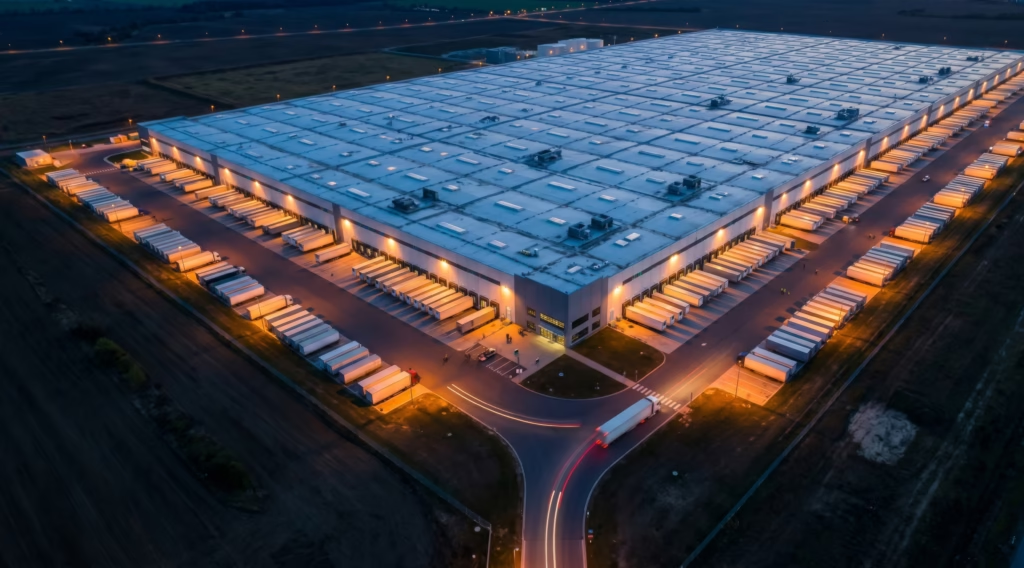
Amazon Is a Tollbooth With a Shopping Cart Painted on It
You came here for an answer. Here it is: Amazon is still being judged like a giant store. That is lazy. Amazon has become a toll system for commerce, computing, advertising, logistics, and soon maybe defense.
Scott Galloway picked Amazon for 2026. The chart people snickered because Amazon lagged the other Magnificent Seven names, spent like a drunken empire, and squeezed its cash flow with another round of capital spending.
Fine.
The more useful read is uglier and more profitable: Amazon has spent years turning itself into the landlord of the internet economy. Sellers pay to reach customers. Companies pay to rent computing power. Brands pay to advertise. Prime members pay to stay trapped in the habit. Governments may soon pay to use its clouds, satellites, and secure infrastructure.
Calling that a retailer is like calling Las Vegas a mattress industry.
The Quick Verdict
Amazon looks like the most misunderstood of the mega-cap tech stocks.
Not the cheapest. Not the cleanest. Not the easiest to model. Just the one where the market still seems half-drunk on an old story.
The bull case rests on five things:
- AWS is still a monster.
- Advertising is becoming a profit machine.
- Third-party sellers keep paying Amazon tolls.
- AI spending may feed several Amazon businesses at once.
- Kuiper, robotics, and Anthropic give Amazon optionality the market barely values.
The bear case is simple too:
- Amazon is spending oceans of money.
- Regulators may wake up again.
- AI infrastructure could become a lower-profit arms race.
- Retail automation will be politically radioactive.
- The stock already lives inside every big tech ETF, so nobody is exactly discovering fire here.
Still, if you own the big tech basket and want one extra bet, Amazon deserves a hard look.
Encadré: The Bare-Minimum Lexicon Before We Enter the Casino
Amazon Web Services / AWS
Amazon’s cloud-computing business. Companies rent computing power instead of buying and running their own servers. AWS is one of Amazon’s richest businesses.
Cloud
Someone else’s computers, rented by the hour. Romantic, no?
Capex
Money a company spends on big physical stuff: data centers, chips, warehouses, satellites, trucks. Amazon is spending heavily here.
Free cash flow
Cash left after the bills and big investments. Wall Street loves it because it can be used for buybacks, debt reduction, or hoarding like a dragon.
Operating margin
How much profit a business keeps from its sales before some financial cleanup items. Higher is better.
ROIC
A measure of how well a company turns invested money into profit. Useful, though often worshipped by spreadsheet monks.
Magnificent Seven / Mag 7
Apple, Microsoft, Amazon, Alphabet, Meta, Nvidia, and Tesla. The market’s celebrity table.
Marketplace
Amazon’s platform where outside sellers list products. Amazon takes fees for access, storage, shipping, placement, and advertising.
Prime
Amazon’s subscription club. Free shipping, video, music, and the sweet narcotic of convenience.
Trainium
Amazon’s in-house AI chip. Built to reduce dependence on Nvidia and lower the cost of running AI systems.
Anthropic
The company behind Claude, one of the major AI models. Amazon invested billions in it.
Project Kuiper
Amazon’s satellite internet project. The obvious comparison is Starlink. The more interesting customers may wear uniforms.
QQQ / VGT
Popular ETFs that own big chunks of large tech companies. If you own them, you already own Amazon.
Amazon’s Real Business: Charging Rent
Amazon sells plenty of goods, yes. So does a gas station. That does not mean the gas station makes all its money on the sandwich rotating under a heat lamp since Easter.
The money that matters comes from tolls.
Third-party sellers use Amazon Marketplace because leaving Amazon is often commercial self-harm. They pay listing fees, fulfillment fees, storage fees, advertising fees, and assorted tolls dressed up in polite corporate language.
A merchant can complain about Amazon all morning and still buy ads on Amazon by lunch. That is power.
Then comes Prime. Prime is not merely a subscription. It is a behavioral prison with decent lighting. Once a household builds its shopping reflex around Amazon, the habit compounds. Need batteries? Amazon. Dog food? Amazon. A cable you will lose in two weeks? Amazon. A book by some dead drunk you swear you will read? Amazon.
The customer stays. The seller pays. Amazon clips the ticket.
That is not retail in the old sense. That is infrastructure with a checkout button.
AWS: The Cash Engine Under the Floorboards
AWS did roughly $128.7 billion in 2025 revenue, according to the draft numbers, with fat operating margins around 35%.
That matters because AWS is not a side hustle. It is one of the central pipes of the modern internet. Startups run on it. Corporations run on it. Government agencies use versions of it. AI companies need it. Streaming, apps, databases, payments, security systems — all of them need computing power somewhere.
Amazon rents the somewhere.
Microsoft Azure and Google Cloud are the obvious rivals. They are excellent businesses. Microsoft may even be the cleaner stock because investors understand it better and have already given it the AI halo through OpenAI.
Amazon’s edge is stranger. It can use its own infrastructure internally across retail, advertising, logistics, robotics, and AI. When Amazon builds a data center, it is not only renting power to outsiders. It can also feed its own machine.
That is where normal retail comparisons die in a ditch.
Advertising: The Quiet Money Printer
Amazon’s advertising business is no longer cute. It is a serious animal.
The draft pegs advertising at more than $21 billion, growing around 22%, with very high profit on each extra dollar of sales.
This business is brutally logical. People search Amazon when they are already near buying. Google catches intent. Meta manufactures desire. Amazon sits close to the cash register.
A brand selling razors, headphones, vitamins, or cat litter has to pay for visibility. On Amazon, invisibility is death. The top of the page is expensive because the bottom of the page might as well be Siberia.
So brands pay. Sellers pay. Amazon collects.
The old store sold shelf space. The new Amazon sells digital shelf space and charges for the privilege of being noticed.
The Spending Panic Is Too Neat
The bear case begins with the spending.
Amazon is expected to pour roughly $200 billion into capital spending in 2026, according to the draft. That is not a budget. That is a sovereign wealth fund having a manic episode.
Investors hate when cash disappears into concrete, chips, warehouses, robots, fiber, satellites, and data centers. They prefer cash coming back through buybacks, because buybacks are easy to understand and require no imagination.
The fear is rational. Huge spending can destroy returns. Tech giants are not immune to empire-building. Plenty of CEOs have built monuments to themselves and called them “long-term platforms.”
Amazon deserves scrutiny.
Still, Amazon’s spending has one unusual feature: the same infrastructure can serve multiple masters.
A data center can support AWS customers, AI workloads, Amazon’s own advertising systems, warehouse routing, voice assistants, robotics, and Anthropic. A chip investment can lower AI costs. A logistics network can serve Amazon retail and third-party merchants. Satellites may serve consumers, companies, and government buyers.
One dollar of spending can touch several revenue streams.
That does not make the spending automatically brilliant. It does make the spreadsheet harder than a simple “capex up, cash flow down, sell” reaction.
Wall Street likes clean lines. Amazon is a filthy knot. Sometimes the knot is where the money is.
Trainium: The Nvidia Tax Reduction Plan
Nvidia has become the toll collector of AI. Everyone needs the chips. Everyone pays the king.
Amazon would rather not spend eternity kneeling.
That is where Trainium comes in. Amazon’s own AI chip is designed to run heavy AI workloads at lower cost. Every internal Trainium deployment means less dependence on Nvidia. Every customer using Trainium through AWS gives Amazon another way to compete on price and performance.
This does not mean Amazon will dethrone Nvidia. Calm down. Nvidia still owns the cathedral.
But Amazon does not need to dethrone Nvidia to win. It only needs to reduce the tax. If AI workloads keep exploding, shaving costs matters. Scale turns pennies into kingdoms.
The market tends to value Amazon’s chip effort like a science project in the basement. That may be too dismissive.
Anthropic: The AI Stake Sitting in Plain Sight
Microsoft gets endless credit for its OpenAI relationship. Some of that is deserved. Some of it is just Wall Street’s weakness for a clean fairy tale.
Amazon has invested more than $8 billion in Anthropic, the company behind Claude. Anthropic has also committed to massive AWS spending over time. The strategic loop is obvious: Amazon funds the AI lab, the AI lab uses Amazon’s cloud, Amazon gains exposure to one of the leading model companies, and AWS gets a marquee customer.
If Anthropic raises money at a much higher valuation, goes public, or gets marked up by private investors, Amazon’s stake becomes harder to ignore.
Right now, investors seem to treat it as background decoration. That is odd. Anthropic may be the second most important AI model company after OpenAI.
Maybe that stake never becomes a giant profit line. Maybe AI valuations sober up and the room smells like stale beer by morning. But Amazon has bought a meaningful seat at the table, and the market has not acted very excited about it.
Good. Excitement is expensive.
Kuiper: The Satellite Story Is Bigger Than Consumer Broadband
Project Kuiper gets described as Amazon’s answer to Starlink. That frame is too small.
Yes, Kuiper could sell internet access to consumers and remote businesses. Fine. Useful. Dull.
The more interesting buyer may be the U.S. government.
The Pentagon does not love dependence on a single satellite network controlled by Elon Musk. Nobody in Washington enjoys admitting dependence on one volatile billionaire with a phone and a mood cycle. Starlink has been useful. It has also reminded governments that private infrastructure can become public leverage.
Amazon already has deep government ties through AWS and GovCloud. Add a satellite layer and Amazon can offer cloud, data, secure computing, logistics, and communications in one stack.
That smells less like consumer broadband and more like defense infrastructure.
Defense revenue gets valued differently from rural internet subscriptions. Same satellites. Different customer. Better story.
Kuiper may fail. Satellites are expensive, launches are hard, and Starlink is not exactly sleeping under a bridge. Still, if Amazon turns Kuiper into a government-grade communications layer, the market will have to revisit the story.
Regulation: The Weather Has Changed
Eighteen months ago, Amazon looked like a trophy target for Lina Khan’s FTC. The breakup talk was loud. The mood in Washington was hostile.
Now the air is different.
The case has slowed. The political environment has shifted. Amazon has made the usual pilgrimage: presence at inaugurations, donations, relationships, soft power. Bezos has adjusted the Washington Post’s posture enough for people to notice. Nobody should pretend this is civics class. This is how big companies survive.
Regulatory risk has not vanished. It never does for companies this large. Amazon will always be a target because Amazon touches too many lives and too many wallets.
But the market may still be pricing yesterday’s danger. A colder FTC, a friendlier White House, or a slower case can all lift pressure from the stock.
Morally inspiring? No.
Financially relevant? Obviously.
Robotics: The Ugly Margin Lever
Amazon has suggested it could automate a huge share of fulfillment work over time, possibly reducing its need for hundreds of thousands of workers.
That sentence should make any normal person pause.
It also explains why investors care.
Warehouses are expensive because human labor is expensive. People need wages, benefits, breaks, safety protections, training, managers, insurance, and occasionally dignity. Robots are costly too, but they do not unionize, call in sick, or develop back pain from moving dog food across a concrete floor.
If Amazon automates fulfillment at scale, the economics of its logistics network change. Third-party sellers already pay Amazon to store, pack, ship, and deliver goods. Lower labor costs mean those fees become more profitable.
This is where UPS and FedEx should start sweating into their collars. Amazon is not merely delivering its own packages anymore. It is turning logistics into a service others rent.
A more automated Amazon can charge rent on commerce and take a thicker cut of the shipment.
Bleak? Sure.
Profitable? Also sure.
Capitalism is rarely improved by staring at it directly.
Why Walmart Is the Wrong Comparison
Investors still reach for Walmart when they talk about Amazon retail.
That comparison belongs in a museum.
Walmart owns stores, sells products, negotiates with suppliers, and runs a phenomenal physical retail machine. It is one of the best operators in American business history. Respect where due.
Amazon, though, has become something stranger:
- A shopping platform.
- A cloud landlord.
- An advertising exchange.
- A logistics network.
- A subscription ecosystem.
- An AI infrastructure provider.
- A chip designer.
- A possible defense contractor.
- A satellite operator.
Walmart is a retailer with technology. Amazon is technology with a retail costume.
That distinction matters because the profit pools are different. Retail margins are thin. Software, ads, cloud, and platform fees can be much richer.
The market knows this intellectually. It still panics whenever Amazon’s retail cash flow looks messy.
Old habits die like roaches.
The ETF Problem: You Probably Own Amazon Already
Before anyone runs off to buy Amazon like a maniac, check the boring stuff.
If you own QQQ, VGT, or a broad S&P 500 fund, you already own Amazon. Not a tiny souvenir position either. Amazon is one of the biggest companies in the market, so it appears in most large U.S. stock funds.
Buying extra Amazon means making an active bet that it will beat the basket.
That is the real decision.
For most people, the boring answer remains correct: own the tech ETF, add regularly, stop refreshing the app, go outside, call your mother.
For people who want a focused bet, Amazon has an argument. The stock has lagged for reasons that may prove temporary: spending shock, lower free cash flow, and rotation into hotter names. Those are market mechanics. They are not proof that the underlying machine is broken.
If the spending turns into durable infrastructure, if Anthropic gets valued properly, if ads keep compounding, if AWS holds its ground, if robotics improves logistics margins, Amazon’s current discount versus sexier mega-cap peers may look stupid later.
A pile of ifs, yes. Investing always comes with ifs. Anyone selling certainty is selling perfume in a bus station.
The Cleanest Bull Case
Amazon’s bull case can be said without incense:
The company is building infrastructure that other businesses, consumers, AI labs, advertisers, sellers, and governments may have to keep renting.
That is the whole thing.
Retail brings the customers. Marketplace brings the sellers. Ads monetize the search. Prime locks in behavior. AWS rents computing power. Trainium lowers AI costs. Anthropic gives Amazon AI exposure. Robotics improves fulfillment economics. Kuiper may open defense and communications markets.
The pieces reinforce each other.
That does not guarantee the stock wins. Great companies can be bad investments if the price is absurd. Amazon is not some forgotten cigar butt trading behind a bowling alley. It is a mega-cap titan already owned by nearly every institutional investor with a pulse.
Still, among the giants, Amazon has one of the more interesting gaps between what people say it is and what it has become.
The market calls it a retailer when it feels bearish.
Amazon keeps collecting rent.
Encadré: Lateral Recommendations for the Curious and the Lazy
Stocks to Watch
Amazon (AMZN)
The main bet. Commerce tolls, AWS, ads, AI infrastructure, robotics, Kuiper, Anthropic. Messy, expensive, powerful.
Microsoft (MSFT)
The cleaner cloud-and-AI compounder. Azure, enterprise software, OpenAI exposure. Less chaos, less torque.
Alphabet (GOOGL)
Owns Google Cloud, Gemini, YouTube, search, ads, and its own AI chips. A strong alternative if you prefer a company with more obvious advertising dominance.
Constellation Energy (CEG)
AI data centers need electricity. Constellation sells a lot of it, including nuclear power. Picks-and-shovels angle.
Vistra (VST)
Another electricity play tied to the data-center boom. Volatile, but relevant.
Anduril
Private for now. Defense-tech company worth watching if it eventually goes public. Relevant to the Kuiper/Pentagon angle.
ETFs for People With Jobs and Better Hobbies
Invesco QQQ (QQQ)
Owns the big Nasdaq names. You get Amazon, Microsoft, Nvidia, Apple, Meta, Alphabet, and the rest of the circus.
Vanguard Information Technology ETF (VGT)
Big tech exposure, though its structure differs from QQQ. Check holdings before buying.
Vanguard S&P 500 ETF (VOO)
The dull classic. Owns the market’s biggest U.S. companies, including Amazon. Cheap, broad, effective.
One Book Because We Are Still Pretending to Be Civilized
“The Grapes of Wrath” by John Steinbeck
Not about Amazon. Very much about power, labor, displacement, and the machinery of American capitalism grinding people into paste. Useful background reading for a world where warehouses automate and workers become line items.
Final Call
Amazon is not a simple retailer. It is a rent collector wearing a retail mask.
The market sees the spending and flinches. Fair. Two hundred billion dollars of capex deserves suspicion. But Amazon’s spending may be building a system that feeds cloud, ads, logistics, AI, chips, satellites, and government contracts at once.
That is why the stock is interesting.