$SOFI vs. $HOOD: The market has the risk profiles backwards
Trump’s crypto embrace and student loan chaos create a scenario where Robinhood’s “risky” business might actually be the safer bet
The pitch
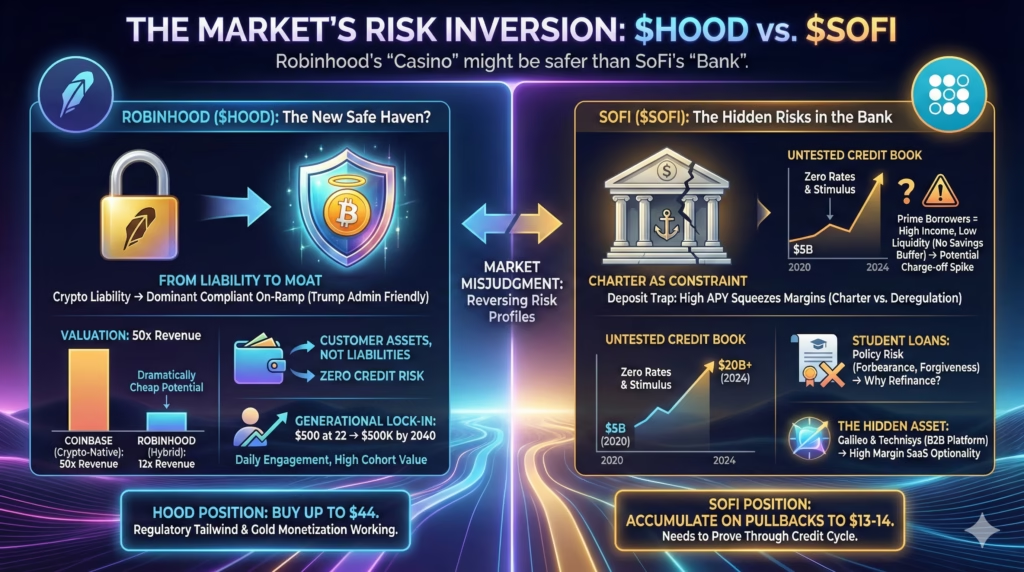
Wall Street sees SoFi as the safe, diversified bank and Robinhood as the speculative crypto casino. The incoming Trump administration is about to flip that script entirely. Robinhood’s 40% crypto exposure transforms from liability to regulated moat as the SEC shifts from prosecution to legitimization, while SoFi’s student loan refinancing business faces potential demand destruction from unpredictable federal policy changes. At $40.50 vs. $15.50, Robinhood’s 12x forward revenue multiple may actually carry less fundamental risk than SoFi’s “cheaper” 8x—the market just hasn’t caught up yet.
The friction
Robinhood remains a levered bet on retail trading volumes that could collapse 50%+ if crypto enters a multi-year winter and meme stock enthusiasm fades permanently. SoFi’s $20B+ personal loan book has never been stress-tested through a real recession. If charge-offs spike from 3% to 5%, earnings get cut in half while the company simultaneously builds reserves.
Neither stock is truly “safe.” The question is which risk the market has mispriced more severely.
Why SoFi’s bank charter may be a constraint, not a moat
The consensus treats SoFi’s 2022 bank charter acquisition as a permanent structural advantage—cheaper deposit funding, regulatory credibility, protection from fintech competition. The contrarian reality cuts differently.
Under Trump 2.0’s deregulatory environment, pure fintechs gain flexibility while SoFi remains anchored to OCC and FDIC oversight, capital requirements, and stress testing that competitors avoid entirely. More critically, SoFi’s charter forces them to maintain capital buffers against credit losses precisely when policy risk is elevated.
The “cheap funding” thesis is already showing cracks. SoFi pays roughly 4% APY on deposits to remain competitive with Apple and Marcus. Even as the Fed cuts rates, SoFi can’t meaningfully lower deposit costs without triggering customer attrition. This means their loan-to-deposit spread compresses rather than expands—the opposite of what a traditional bank charter should deliver. With deposits at $24B+ and loan demand uncertain, they may be paying 4% for cash they can’t profitably deploy.
Here’s the thing—student loan refinancing, SoFi’s founding business, faces genuine structural headwinds regardless of rate cuts. If Trump extends forbearance, expands income-driven repayment caps, or creates new forgiveness pathways, the value proposition of refinancing federal loans into private debt collapses entirely. Why sacrifice federal protections for marginally lower rates? Student loans still represent roughly 15% of originations and a critical member acquisition funnel. If this channel shrinks permanently, the “full-stack financial platform” narrative weakens considerably.
The bear case has merit: SoFi’s charter might be worth 2-3x revenue premium in a hostile regulatory environment but becomes an anchor in a permissive one. The bull counter is that deposit gathering remains valuable regardless, and personal loans can replace student loan volume. Watch deposit cost spreads and any Trump administration student loan policy signals in Q1 2025.
Crypto legitimization transforms Robinhood’s liability into its best asset
The dominant narrative frames Robinhood’s 40%+ revenue exposure to crypto and options as an existential vulnerability. The contrarian view: this exposure is about to become a regulated moat.
Trump’s administration has signaled unprecedented crypto friendliness—Gensler’s departure, Bitcoin reserve discussions, a cabinet stacked with crypto advocates including Musk and Lutnick. If crypto gets regulated into legitimacy rather than persecuted into oblivion, Robinhood becomes the dominant compliant on-ramp for 50M+ Americans. Robinhood has 24M funded accounts with 11M active crypto traders—infrastructure already built for a world where Bitcoin becomes a permanent regulated asset class.
Bitcoin’s December 2024 run above $100K isn’t the end. It’s the market pricing in regime change.
Compare valuations: Coinbase trades around $300 at roughly 50x revenue as a crypto-native exchange. Robinhood at 12x revenue looks dramatically cheap if crypto normalizes as a permanent 10%+ allocation for retail portfolios.
Payment-for-order-flow, supposedly Robinhood’s other vulnerability, survived the Gensler SEC at maximum hostility. Under a deregulatory administration with an industry-friendly SEC chair, the attack surface shrinks further. This reminds me of the early 2000s discount brokerage wars—everyone said Schwab would crush the upstarts, and look how that turned out. Multiple academic studies show retail investors actually get better execution via PFOF than on lit exchanges—this argument gains traction in a “pro-retail, anti-establishment” political environment. Robinhood’s December 2024 SEC settlement ($45M fine over historical disclosures) may have cleared the decks rather than signaling ongoing risk. PFOF has fallen from 65% of revenue in 2021 to roughly 35% in 2024, with Gold subscriptions now exceeding $150M ARR.
Bears correctly note that crypto revenue could collapse 70%+ in a prolonged winter, as it did from 2022 highs. But the probability distribution has shifted. Crypto entering the traditional financial system through ETFs and potentially sovereign reserves creates a floor that didn’t exist before. New SEC chair statements in Q1 2025 will clarify whether PFOF risk evaporates or intensifies.
SoFi’s credit book is untested at precisely the wrong moment
SoFi reports a pristine 0.55% 30+ day delinquency rate as of Q3 2024, with average personal loan FICO scores around 750. The market interprets this as disciplined underwriting.
The contrarian interpretation: we’ve never seen this portfolio perform through a real credit cycle.
SoFi scaled its personal loan book from roughly $5B to over $20B between 2020 and 2024—during zero rates, stimulus checks, and the greatest asset bubble in history. These loans have only existed in a world where everything went right. SoFi’s “prime” borrowers skew toward young professionals with high income but often low liquidity and high lifestyle leverage. This is exactly the demographic that got crushed in 2008—high FICO scores mean nothing when the borrower has no savings buffer and loses their tech job. Delinquency rates tell us nothing about loss-given-default in a layoff-driven recession.
Robinhood holds essentially zero credit risk. Customer assets, not customer liabilities. If unemployment rises from 4.2% to 5.5%+ in 2025—not a recession, just normalization—personal loan charge-offs could spike from 3% to 5%, cutting SoFi’s earnings power in half while simultaneously requiring reserve builds.
SoFi’s increasing reliance on gain-on-sale creates additional hidden risk. This model depends on capital markets appetite for consumer ABS. If credit spreads widen by 200 basis points—not a crisis, just normalization—gain-on-sale margins compress from 4-5% to 2-3%, vaporizing profitability despite healthy origination volumes. The market prices SoFi as a traditional bank. It’s actually a hybrid bank-originator with capital markets exposure.
Bulls argue SoFi’s underwriting has improved dramatically since their early student loan days and that the high-income borrower base provides resilience. Any tick in net charge-offs above 4% should be treated as an early warning signal.
Robinhood’s generational lock-in creates underappreciated lifetime value
Robinhood owns 70%+ market share among first-time investors. Not by accident—through product-market fit with a generation expecting investing to feel like a mobile-native experience.
The typical framework values HOOD on current monetization: roughly $113 ARPU overall, $300+ for Gold subscribers. The contrarian framework values cohort lifetime value progression. A 22-year-old opening a Robinhood account today with $500 could have $500K with them by 2040 if they never churn. Current ARPU dramatically understates the embedded value of this customer relationship.
The evidence already exists in cohort data. Robinhood’s oldest users (2015-2017 signups) show dramatically higher AUM and engagement than newer users—they didn’t leave for Schwab as they got wealthier, they deepened their Robinhood relationship. The new Robinhood Legend desktop platform (launched late 2024) shows management understands this progression: advanced charting, options analysis, and futures access target the power users who generate 10x+ revenue of passive investors. Gold subscriber growth (6.5M+ as of Q3 2024) demonstrates monetization expansion working.
SoFi claims $9 in annual revenue per product per member with 1.6M members using 3+ products. This cross-sell story is real but slower than Robinhood’s engagement-driven monetization. SoFi’s products—loans, banking, investing—are used occasionally. Robinhood’s products are used daily. Engagement frequency drives habit formation and switching costs.
Bears correctly note that Gen Z’s financial behaviors could shift, and that Robinhood’s “gamification” reputation may cap their ceiling with older, wealthier demographics. Watch Gold subscriber conversion rates and Legend adoption metrics through 2025.
The hidden asset: Galileo is worth more than zero
SoFi’s Galileo and Technisys platforms process over 150M accounts for fintech clients including Chime, Dave, and MoneyLion. This is completely different economics than consumer banking—recurring SaaS revenue with 80%+ gross margins and high switching costs.
Comparable B2B fintech infrastructure companies trade at 5-15x revenue. Galileo likely generates $500-700M annually at 20%+ growth. As a standalone entity, it could be worth $5-10B.
The market currently values Galileo at essentially zero, treating SoFi as a pure consumer bank. SoFi’s entire market cap is roughly $16B. If Galileo were properly separated and valued at even 8x revenue, the “stub” consumer business would trade at 4-5x revenue—either cheap if you believe in the bank, or fairly valued if you’re skeptical. This is genuine optionality that the consolidated multiple obscures entirely.
A Galileo spin-off or IPO could unlock substantial value if SoFi’s stock underperforms over the next 12-18 months. Management has shown no interest in separation, preferring the integrated narrative. But activist pressure builds when hidden assets remain hidden. Robinhood lacks any comparable B2B optionality—their value is entirely consumer-facing.
Galileo provides meaningful downside protection for SoFi even if the consumer thesis disappoints. This partially offsets the credit and policy risks.
The bottom line
Both stocks have tripled off 2022 lows. At current prices—Robinhood at $40.50 and SoFi at $15.50—the contrarian case favors Robinhood despite its higher multiple.
Buy HOOD at current levels up to $44. 12x forward revenue is reasonable for 35%+ growth with crypto legitimization tailwinds and zero credit risk. The regulatory environment is shifting from headwind to tailwind, Gold subscriber monetization is working, and generational lock-in creates underappreciated lifetime value. Full weight for growth portfolios.
SoFi is more complex. The Galileo optionality and deposit franchise have real value, but the untested credit book and student loan policy risk create hidden fragility the market underprices. Accumulate SOFI on pullbacks to $13-14 rather than chasing at current levels. The “safe bank” narrative requires proof through a credit cycle that hasn’t arrived yet. Half weight until charge-off trends clarify.
For HOOD, watch crypto trading revenue share through Q1-Q2 2025—should stay above 30% of transactions revenue. Gold subscriber growth targeting 8M+ by year-end. Any SEC policy reversals. Thesis breaks if crypto enters multi-year winter below $50K Bitcoin AND retail trading volumes collapse to 2019 levels simultaneously.
For SOFI… watch personal loan net charge-offs. Exit if exceeds 4.5% for two consecutive quarters. Monitor deposit cost spreads as the Fed cuts, and any Trump student loan policy announcements. Thesis breaks if student loan refinancing volumes don’t recover AND credit losses spike above 5% in a slowdown.
The market thinks it knows which of these is the risky bet. It might have it exactly backwards.